Sunday, March 5, 2017

Australia Was Fun in 2013


In January of 2013, Kriss and I went to the Snowy Mountains part of the Australian Alps to climb Mount Kosciuszko.  Australia is a continent and even through Kosciuszko only stands 7,310 ft above sea level, it’s the highest mountain in Australia and therefore one of the Seven Summits. 
Traveling by car in Australia was enjoyable.  It was like being in the United States but on a different reality plane somehow.  We found the people to be friendly and hospitable and they were definitely more laid back than we Americans are.  They spoke English obviously but with that great accent that makes you want to crack open a beer and listen to a story about the outback.  They also drive on the other side of the road, which took a fair bit of concentration for me to make good decisions within intersections and roundabouts.  The best part though was their road signs.
 
 This was ski country for Australia and the broader part of the mountain’s base comprises the Thredbo ski resort.  Being there in the summer time, the resort was nice and quiet and we had many good choices of hiking trails to achieve our summit goal.
 
Like many ski resorts, Thredbo runs their chair lifts in the summer time for tourists.  This gives many people the opportunity to hike above tree line without having to climb all the way up on their own.  Of course, since this was to be one of our Seven Summits, there was no chair lift in our plans.  In fact, we decided to take the longest route possible in order to feel like we earned the summit.  Our route started with the Merritts Traverse, connecting to the Merritts Nature Track then to the Mount Kosciuszko Track up to the summit.


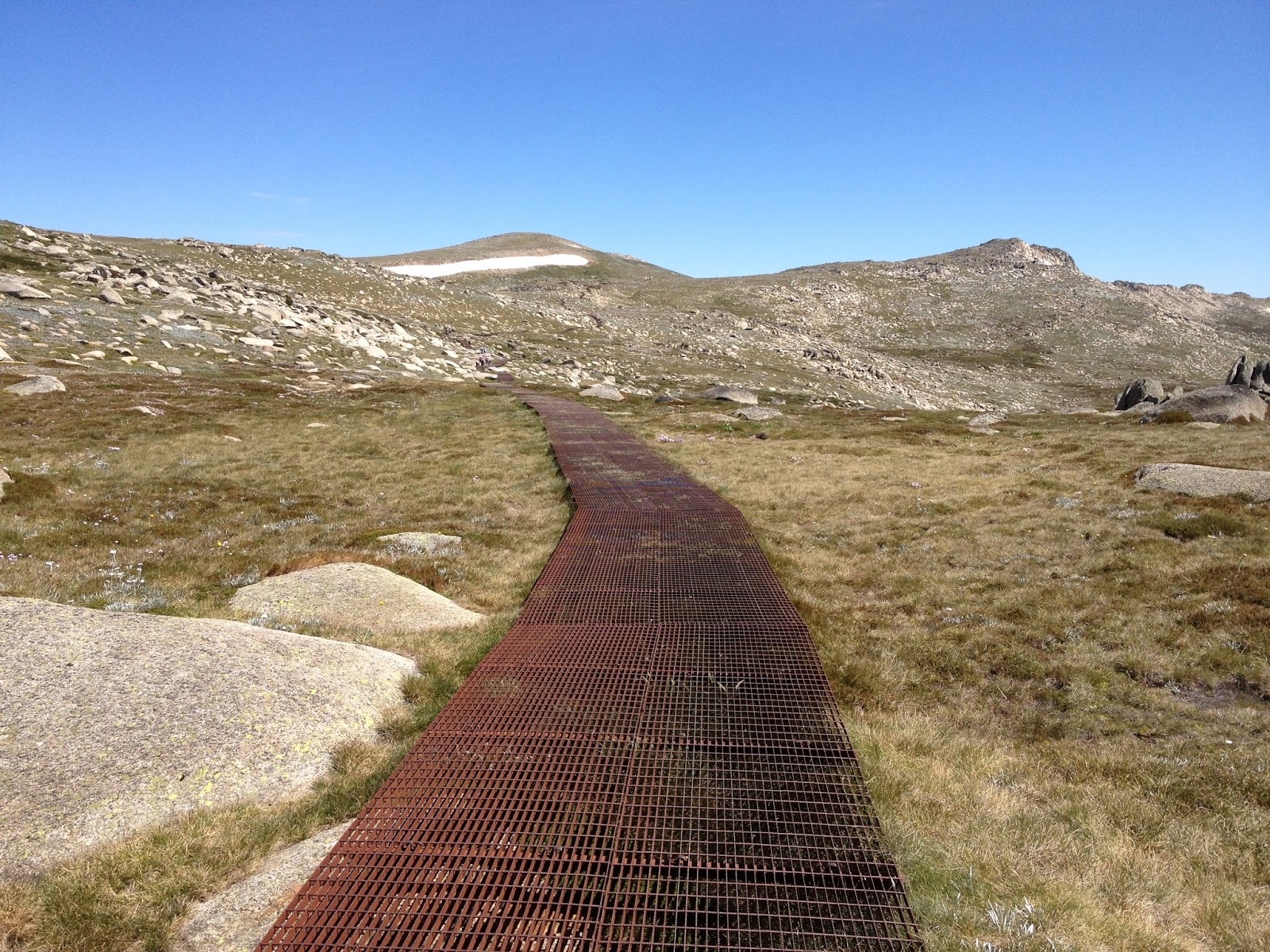
Since the route is accessible to most people of reasonable fitness, it gets a lot of traffic.  The local authorities have taken precautions to protect the fragile alpine flora by installing metal walkways along the route.  Seeing this preservation method reminds me that we in Colorado are loving our 14ers to death and that maybe something should be done in the locations most susceptible to damage by human traffic.

We reached the summit along with 50 or so others from all over the world.  Being on the highest point for thousands of miles around is always a thrill and we were happy to be there.  
The return route followed back down the Mount Kosciuszko Track then veered off the map on Dead Horse Gap Walk and finally returned to the village via the Riverside Walk.  All in all, it was over 18 miles and 3,000 feet of elevation gain which took us about 10 hours of dedicated hiking.  With a 30# day pack, it would have scored well on the PFM scale.

Kosciuszko was now the 5th of our Seven Summits climbs successfully completed, leaving Vinson Massif in Antarctica and Mt Everest in Asia.


Saturday, February 18, 2017

I'm Only Human!

Training for Everest continues on a daily basis with two workouts on most days except on weekends where the efforts are usually more intense.  On a Saturday in the beginning of February, we decided to investigate a loop that we believed existed on Forest Service roads off the Fall River Road.

As it turned out, we had perfect conditions for snowshoeing.  Less than 6 inches of new snow with firmer stuff underneath.  There were no human tracks on the entire route which was a rarity for accessible routes in Colorado. We had about five hundred acres to ourselves from the looks of it.
After a half mile or so, we came across tracks from two Moose!  What a great surprise this was and the dogs were going completely crazy.  Based on the track condition, it looked like they came through the night before.
The stride on these animals is pretty impressive as you can see.  The size of their hooves is surprising up close.  Once you soak this all in, you also remember that Moose are not friendly and can be quite territorial.  We're thankful they've moved on and left only tracks for us to see.
Further up the trail, it became obvious that many forest animals were out the night before and earlier that morning.  We saw tracks from Fox, Rabbits, Squirrels and little mice or moles.
It really was a nice day to be outdoors training.  The weather was cloudy and threatening but never amounted to much.  At the high point of our loop we had some wind, but nothing like many of our recent hikes/climbs.
We managed to traverse a small ridge and enter a familiar drainage where the route back down was familiar to us.  The loop existed and was exactly what we were looking for!
 We will hereafter refer to this route as Moose Loop!  It's now one of our favorite snowshoe routes and we were fortunate to have it all to ourselves.  Stats: 4.5 miles, 1,061 ft elevation gain, 10,880 ft max elevation, 58# pack weight.  All in all, a great day!

The next day was Sunday and the pressure was off for a hard training day after Moose Loop.  I slept in, roamed around the house for a bit then decided to run the mountain loop where we live.  You've seen it before but for review, it looks like this
Okay two loops, one with each dog and my obligations for the day are over!  Mocha is first of-course because I want Tessa to pull me on the second round.  Well, for some reason my legs weren't feeling too bad from the day before and my lungs were working great.  At the high point of the second loop I decided to make the third loop just like last time. 

This is a classic training technique for me - commit to something reasonable, knowing full well that the stakes will change once the suffering has commenced.  So here I was, charging downhill towards the end of the second loop having ideas about turning in a world record for the triple loop run.  Tessa was ejected at the house and back out I went for #3.

The first 3/4 mile is downhill and I was an Olympic athlete showing my speed on snow covered mountain roads.  As soon as I turned the corner and started up the 1.25 mile long uphill stretch, the picture looked a little different.  Just breathe and keep a rhythm in the stride.  Watch out for the ice and don't get bit by the 5# mean dog at the little house on the left.  Pass the junkyard house and focus hard on the ridiculously steep section leading up to the crest.  Try not to drool too much as the breathing ramps up for the last 100 steep yards. 

Okay, the road is flattening out and I'm not dead.  Just one more gradual hill and I'm at the top.  Stay on the hard snow, avoid more ice, focus on breathing and foot placement.  Hurray, I'm at the high point!  It's all downhill from here.  Since I'm not planning much for the rest of the day except a little wood splitting, why not crank up the speed for the last downhill I ask myself.  There's really no reason as long as I don't fall and break a leg.  The last half mile is a running, breathing, grunting and drooling show of effort which nobody sees thankfully.  I pull into the driveway, run up the hill and stop the watch.  Holy crap, a world record!  The Triple Loop run is about 7.64 miles, 1,912ft elevation gain with max elevation of 9,621 and I did it in 90 minutes, 34 seconds, knocking 3-1/2 minutes off last time.

After taking a shower and eating 1,500 calories or so, something happened to me:
Apparently I'm only human, just like the rest of you earthlings.  It was the first nap I've taken in more than a year but I couldn't resist it any more than I can resist the constant pull of gravity.

Training stats to date:
Total Miles Running, Climbing & Hiking - 320
Feet of Elevation Gain - 89,143
Mountaineering Work - 875,475 PFM-HR
Push-ups - 5,531
Sit-ups - 7,660
Weightlifting - 29 Hours


Saturday, January 28, 2017

New Math 2

Last week I took our two dobermans for a walk, it looked like this:
On the surface, it looks like a pretty nice walk in the mountains.  The route is scenic with nice elevation loss and gain and the views are pretty nice.  Adding to the reality of our idyllic little dog walk included details like the fact that we were on an unplowed 4 wheel drive road in January during a snowy stretch with an elevation over 9,000 ft and oh yes, my pack weighed 58#.  Thankfully the wind was only 15-20 mph and gusty.  It's a funny thing to have some body parts sweating while others are cold at the same time.  Aah more practice suffering. 

It's on these little jaunts that I think about lots of things basically to take my mind off the hard work, which brings me back to math.  If you've read the previous blog titled New Math, you'll remember that I developed a revolutionary mathematical concept for mountaineering effort or work.  Now, like all great minds before me, I received feedback on my thesis both positively and negatively.  I would like to take this moment and remind my engineering friends that I basically made this stuff up while in a physically induced hallucinatory haze and wrote it down while drinking wine.

Okay now that the air is clear, let's get back to the math.  There were two comments that I thought were interesting and worthy of further evaluation.  The first was from a friend's father who suggested the PFM formula should account for a person's weight in a more fair manner to somehow normalize the effort.  His argument is that a heavier person will appear to have performed less work carrying the same pack weight as a lighter person. 

Now there are a few ways to look at this argument.  In a pure engineering sense, I agree that a straightforward "work" formula neglecting the person's weight matches textbook theories more closely.  If the heavier person is in worse shape than the lighter person, the effort would be the same or even harder because of the additional body weight.  But someone like Hulk Hogan who weighs over 300# of pure muscle in his prime, carrying the same 50# pack as me at 175# would have a much easier time of it. 

So I think the first thing is to establish a criteria for using the PFM formula which states that for a reasonably athletic and fit person, mountaineering work can be expressed as:

Mountaineering Work = [(Body Wt+Load Wt)/Body Wt] Pounds x Elevation Gained in Feet x  Miles walked or Run = PFM

 Here's an example from a run I did last weekend:
This is the mountain run near our house.  Seems straight forward enough and we've seen it before.  But how about this part:
I did it three times last Saturday, first with Mocha, next with Tessa and the last loop by myself.  Obviously the plan was flawed because I should have saved the ever loving pulling machine Tessa for the last loop.  Stats for this bit of weekend exercise are 7.62 miles, 1,881 ft elevation gain and 1:34 to complete including about 3 minutes for dog swapping.  It was hard!

Mountaineering Work =  14,418 PFM

This was one of my hardest workouts with second highest PFM rating and it only took 94 minutes!

As is my habit, when the going gets tough, my brain does funny things.  During one of the more lucid parts of the run, I was thinking about the other feedback I received from a friend we'll call LW.  Now just for a little background, LW is one of my more physically exuberant friends.  She's the type of person who travels around the country running marathons for fun, trains for and participates in triathlons during all sorts of weather and basically likes to torture herself as much or more than I do. 

LW's comment related to the absence of a time factor in the Mountaineering Work formula.  She said that it's obviously harder to the same task faster than it is slower.  Of course I initially received this comment as an affront since she can run faster, bike faster swim faster and probably do most everything faster than I can.  But after letting it stew for a while and then thinking about it again as I was running mountain loops, I realized what she was really getting at.  It's a level of effort thing not just a speed thing.  I've been passed by people much older than I am while running races and they seem to be hardly working while I'm breathing hard just trying to maintain pace. 

Sorting through the idea while ascending the steep hill during the second loop, I could feel the heartbeat in my neck and realized I was pushing hard and my pulse was pretty high.  Could that be it?  What if there was a factor related to heart rate (level of effort) that was included in the formula?  It would have to account for normal resting heart rate and there would need to be an averaging over the duration of activity.  Without going crazy, my conclusion during the next downhill was to add a factor which is simply:

Average Working Heart Rate / Resting Heart Rate

Based on the original Mountaineering Work formula, you would get the same result if the three loops were done at a casual stroll taking 3 hours or more as you do with the 94 minute run.  Aha, LW was definitely onto something.

So now, let's rework the numbers with the heart rate factors.  My resting heart rate is about 58 and during the run I've estimated from a couple checks that it averaged about 145.  The new factor is then 145/58 = 2.5 and the total mountaineering work for the triple loop run is an impressive 36,045 PFM!

Ha, it's just a number but that makes me feel pretty good.  Training is going well.  Kriss joins me on the weekends and some mornings and I usually have company during weightlifting sessions at Pipestone.  Treadmill time is my own and I try not to stare at the View of the World from the Summit of Mt. Everest photo too hard.  I'll see that view for myself soon enough....
Training Statistics

Miles Climbing and Running - 299
Elevation Gain - 80,129 ft
Push-ups - 5,021
Sit-ups - 6,250
Weightlifting - 24 hours
Mountaineering Work (No HR Factor) - 344,140

Sunday, January 22, 2017

Off to Russia!

The highest mountain on the European continent is Mt. Elbrus at 18,510ft.  It's situated in a wild and mountainous region called the Greater Caucasus range which runs from northwest at the Black Sea to southeast at the Caspian Sea and generally forms the border between Russia and Georgia.
For someone who grew up during the cold war, traveling to this part of the world has a special meaning.  My first job out of college was designing nuclear submarines for use against our number one enemy the Soviet Union.  Now I was traveling to a remote part of Russia to climb a famous mountain.  It's strange how things change over time.

The jumping off spots for Elbrus are the small mountain towns of Terskol and Cheget.  Traveling to this region required a stopover in St. Petersburg which is a beautiful city and worthy of bucket list status.  After a couple days experiencing Russian culture, we flew to a small town called Mineralnye Vody and took a van ride for 5 hours past multiple sketchy roadside checkpoints.  Arriving in the mountain region, we came to a lodge in Terskol and were happy to have a home and be on foot for a while.
We spent the next few days taking hikes and exploring the local region.  the scenery was strikingly beautiful and rugged.  One day, we hiked up an old ski area and got a nice view of Mt. Elbrus in the distance with it's distinctive double summit.
After a few days of acclimatization hikes, gear sorting and eating well, it was time for the main event.  There's a small ski area on the flanks of Mt. Elbrus so why not take our backpacks on the lift and get a ride up to 12,000ft?  In some ways it felt a little like cheating but really, where's the challenge in hiking up a trail for a few thousand feet?  Arriving at the top, we had a couple mile trek to a small hut with two bunk rooms and an eating area.  These were high class accommodations although sleeping in the same room with 6 or 7 other people takes patience and ear plugs.
The lower part of the mountain was surprisingly warm during the day and we wore short sleeves during an acclimatization hike up to the Pastukhov Rocks.  Shown below is the well-oiled Colorado team.
The next day was summit day.  Unlike previous big mountain climbs, we didn't stay in multiple camps on Elbrus.  Everything above 13,000ft or so is open country and very exposed.  Summit day is a huge 5,000 foot plus effort from the hut.  Unfortunately our day started with winds in the 40 mph range well before sunrise and continued for the entire day with gusts over 60 mph.  Wind direction was basically in our faces all day and it really took a toll both physically as well as mentally.  Remember previous explanations about practicing suffering?  This is why.
Photos cannot convey the miserable nature of our summit day but maybe the look of the ground blizzard above gives some indication.  We trudged up the broad slope, stopping only briefly a couple of times to take a quick drink, eat a snack and add a layer on the way to the saddle between the two summits.  Lingering any longer and the cold seeps through your layers and into your bones.

At the saddle, we rope up for the exposed ascending traverse.  We're a good 5 or 6 hours into it by now and the notorious wind is unyielding.  Finally after another 90 minutes or so, we reach the summit.  The photos below could be from any miserable snow covered summit well above treeline on any continent in the world, but it was Elbrus and Alan, Debby, Kriss & I had it all to ourselves.
The descent is generally the most dangerous part of any big climb.  Fatigue is setting in and the inspirational pull of the summit is replaced by the realization that you've still got a long way to go before getting back down to camp.  Descending the traverse in high winds with shifting snow under foot and significant steep exposure to our left requires a high intensity focus.  As the anchor at the back of the rope, I'm watching everyone's feet, hyper aware that one misstep could rip our team off the mountain and send us sliding down the steep slope. 

Thankfully we reach the saddle without incident, stow the rope into my pack and continue the slog back to the hut and a hot meal.  This was the biggest summit push so far in our experience and we feel good about our accomplishment.  Without the wind, it would have been tough but enjoyable.  We found out later that wind on Elbrus is one of the biggest factors for teams not reaching the summit.  
Back from the climb, we had the chance to view Mt. Elbrus one last time from across the valley.  What a striking view of a beautiful mountain!