Sunday, January 15, 2017

Training Ramps Up!

A big part of success in the mountains starts months before the climb.  While training for any sport takes time, discipline and fortitude, mountaineering seems to require a significant amount of suffering, both during training as well as during the actual climb.  I assume this is true for other sports as well, when the participant is looking to achieve the very best that they can but my experience in over exertion lies in the mountains mostly. 

Many friends have mentioned living vicariously through my mountaineering adventures over the years.  Those climbs included a few stories and photos, including the summit shot of course but no real depth so here's a look at some of my training routines.

St. Mary's Glacier
Local hikes and climbs are fun and we do lots of them for training, exercise and overall enjoyment.  What better way to train for climbing mountains than to climb mountains?  A little while ago, Kriss and I went up for a quick climb of St, Mary's Glacier and beyond depending on how it goes.  It was a particularly energizing day as you can see below

We had some nice new snow and there was about a foot of powder on the trail.  The temperature was a balmy 18 degrees at the car so let's just say it was less than that on the glacier.  Oh and yes there was just a little bit of wind, maybe 20 mph sustained with those gusts that stand you up and halt all forward progress when they slam into your chest.  I think that happens at about 60 mph.  A couple of miles up, we decided that was enough.
What usually happens to me when climbing with a heavy backpack is a general dissension within the ranks of my clothes in the area around the waist.  It all starts off great but then the pants slide down and all the upper layers begin to ride up, under the backpack waist belt.  Eventually a gap develops between the bottom edge of all the upper body layers and the top edge of all the lower body layers.  This particular day was no different but I really didn't notice until we turned around and the first 60 mph gust hit me from behind...    

Mornings at Pipestone
Most mornings I begin the day at Pipestone at about 6:30 with a brisk walk on the treadmill.  It's a simple 45-60 minute workout which starts with putting on my old friend the Denali Pro backpack.  It's got a variety of things in it including two tents, a climbing rope and a few dumbbells.  Total weight right now is about 45#.
I start the treadmill at a 5% grade and within a few minutes it's topped out at 10% with gradual speed increases all the way up to 4mph (15 min pace for you runners).  The result includes heavy breathing, lots of sweating and worked legs.  Exactly what's needed on a regular basis.  Note the photo in front of the treadmill.  It's titled "The World From the Summit of Mt Everest"

James Peak Today
This morning was beautiful so we headed out for a climb of James Peak.
Feeling pretty strong, I threw an extra pair of boots into my training pack along with another water bottle.  Total weight, 58#.  The climb started reasonably enough with the usual steep slope but thankfully a complete lack of wind.  Oh, what a beautiful day this will be I thought.  It's a rare treat to be up high without getting blown around.  Kriss was also feeling good and we had high hopes that the morning clouds would lift.
A few miles into the climb, we noticed the air was starting to feel damp and the clouds were lowering to meet us.  We could still see slivers of mountains in the distance rising above the trees and into the clouds.
Hitting the steep slopes of James Peak, I began to wonder about the judgment displayed earlier within the warm confines of our house.  There, with a warm cup of coffee to drink and walking around in my slippers, it sounded like a great idea to throw a few random things into the top of that cavernous Gregory pack.  Now, at 12,500' and climbing a 45 degree slope, my back and hips are complaining.  But, like a good mountaineer, I realize the value in suffering for practice so onward we went for a few more hundred vertical feet until we hit our turnaround time.
It's just as well that we were done.  We were climbing in the clouds with visibility of about 100 ft and a breeze was starting to develop.

Running loops and thinking about math
Yesterday I decided to take our dogs for a run.  They're both fully grown exuberant Dobermans and the roads around our house are snow packed so the prudent thing was to take each separately for a loop around the mountain.


Tessa is absolutely crazy and pulls like a Clydesdale so most of the first loop was spent in self preservation mode.  Mocha on the other hand is a pretty good boy unless we see cars or other dogs.  Of course we saw two cars and one other dog who happened to be running loose and was interested in our little adventure.  At one point I was dragging my boy up a steep hill to create separation between the two dogs.  More good training I guess!  After that, we had an uneventful couple of miles together and my mind turned back to the New Math post and all of the good feedback I received from my fellow engineering geek friends.  One suggestion had me puzzled and I finally worked out a suitable solution worthy of an equation revision.  Stay tuned for New Math 2.

Training Statistics
Just for fun, I've been keeping a spreadsheet.  I know that's a surprise to most of you who know me but please don't post any comments.  Here are a few totals to ponder:

Miles Climbing and Running - 264
Elevation Gain - 68,516 ft
Push-ups - 4,171
Sit-ups - 4,000
Weightlifting - 16 hours

Sunday, January 1, 2017

Denali Was in 2010

Denali (The High One) is the highest mountain in North America at 20,310 ft.  It was also my favorite expedition climb.  There's something about a mountain in Alaska which rises from just above seal level to almost 4 miles in the air.  Add to that, a treeline close to 2,000 ft in elevation and you've got a remote, cold and wild beast of a mountain to climb.

The buildup for any expedition can be long, hard work, exciting and a bit nerve wracking.  Understanding that climbing Denali requires hauling very heavy loads for weeks, we took our training very seriously.  Besides the usual running, hiking and carrying a heavy pack, we climbed and camped on top of 13ers and 14ers in Colorado all winter and spring.
In order to keep the tent secure in the winter winds, lots of anchors were required.  Snow walls are also a good idea to make life a bit more bearable.

Our climbing buddies Alan & Debby joined us on lots of the outings.  Crazy dog Jax also braved the cold weather with us.
We even traveled to New York to be with my family for Christmas and managed a winter climb of Mt. Marcy in the Adirondacks.  Picture high winds and below zero temps.

By June it was time to get on a plane to Anchorage and head up to Talkeetna which is the jumping off spot for Denali.  Once there, it's a waiting game for weather good enough to fly to base camp.  We waited for 3 days and it became easy to lose the psychological edge.
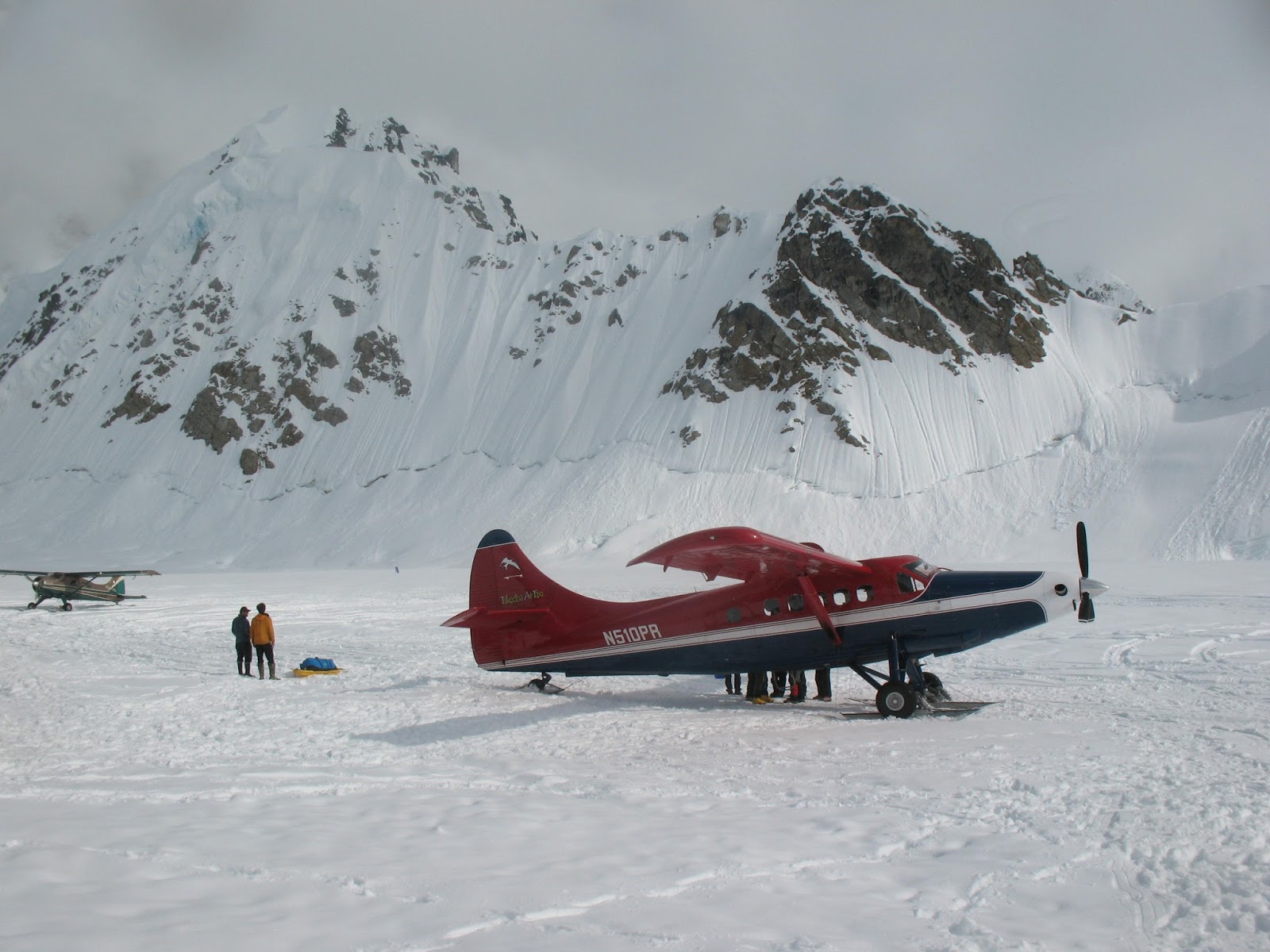
Then we get the call and all hell breaks loose.  Get your gear on the plane and let's go!  Obviously weather in Alaska is unpredictable so you don't want to waste a good window of opportunity.  It's a beautiful flight over remote country and you almost feel like a summer tourist until you see it.
That's when everything becomes real and you get that funny feeling in your gut.  Then you think, "holy crap I'm going up there.  Boy I hope this goes well".  It's a different thing to know that every climb happens step by step and that you've trained hard and our gear is dialed and then to get a look eye to eye with the objective.  The only things you can see at this point in all directions is snow, ice and rock.  It's humbling and exhilarating at the same time.  In a few minutes we land on the Kahiltna Glacier, unload hundreds of pounds of gear and reality sets in.
The Colorado crew is anxious to get moving after waiting in Talkeetna.  We know the hard work of climbing brings accomplishment, endorphins and calms the "monkey mind".  At least on the West Buttress route, the lower half of Denali is climbed at night when the snow is firmer and the chance of falling into a crevasse is reduced.  Our team comprises two rope teams of 5.  We are bound by the "brotherhood of the rope" during the next 16 days, each one of us in turn being vigilant and alert for the safety of our teammates.
We climb, rest, eat, climb, camp and repeat.
There are clear days, snow storms, miles to cover and feet of elevation to gain.  Every step of the way, we keep track of ourselves and our teammates.  We keep eating even though we're not hungry, we keep drinking even though it's cold and there's slush in our water bottles and we keep moving to stay warm and to make progress.
Along the way we manage to have a little fun.  Basin camp is at just over 14,000 ft and it's really the last somewhat protected place to camp before heading to the summit.  Hi camp is above at 17,200ft but you don't want to be there any longer than you have to.  During a rest day at Basin Camp, we carved out a table and benches for a game of cards.
Later, up on the "16 Ridge", Dave and Eben hammed it up showing off their huge guns and bigger packs. 
Moving up to high camp takes significant effort and two trips in order to have enough gear, food, and fuel for our summit push.  It's also quite possible to get caught up there for a week or more in bad weather so skimping on supplies is not a wise move.  Once we arrive, we build a fortified camp with three foot snow walls.  Winds can reach well over 150 mph up here and losing a tent is not an option.  In the photo below, you can just barely make out the ascending traverse route up the "Autobahn" to the saddle.  This will be our first obstacle in the morning.
Summit day starts at 7am and it's minus 25 degrees.  We have over 3,000 ft to climb and will be breaking trail most of the way.  It's been 3 or 4 days since anyone was on the summit due to poor weather.  Avalanche danger is on our minds in addition to the usual things that can hurt or kill you up here.
We keep the rope stretched out for safety so communication is minimal between us.
Finally after 12 long hours, both teams reach the summit at jsut after 7pm.  The sky is blue, winds are calm and we can see 100 miles or more.  Even though the temperature is minus 20 or less, we feel great!
 After much celebration and enjoying the view, we turn to head back across the summit ridge and down towards our high camp.  Mountaineers know this is usually the most dangerous part of a climb.  the summit has been achieved and exhaustion begins to creep into our legs.  Many places along the route are "no fall zones" and require vigilance by all.  Mount Foraker has been our companion during the climb and can be seen beyond the summit ridge of Denali below.
Descending Denali takes us less than 2 days.  Once the goal is achieved, all minds turn towards getting down safely to more oxygen, better food and a hot shower.  Reaching base camp in early afternoon, we're informed by the park ranger that weather is too poor for flying and we'll be spending the night.  Below you will see a combined pile of gear and sleeping climbers.  Basically we crashed for a few hours, all the work done safely and successfully.
Finally after waiting for three days of bad weather during which we packed a runway down multiple times with our snowshoes, a plane arrived to pick us up.  We spent a total of 19 days on this beautiful and wild mountain.  We achieved our goal safely and were thankful for the experience.  We were ready to leave.
There are many routes to climb Denali.  Some are historical and rarely used, some are very technical with limited success rates and the most popular is the West Buttress route.  Many thanks to our teammates and Alaska Mountaineering School for their professional mountain guides and their support during our preparation for this expedition.
The 4th mountain in our quest for climbing the Seven Summits is Mt. Elbrus in Russia......

Monday, December 12, 2016

New Math

I took a run the other day near our house in the mountains.  It looked like this:


Now running a half dozen miles in an hour isn't anything spectacular, even for a late blooming runner like me.  The interesting part is taking that same run in the mountains with elevations above 9,000ft on dirt roads with grades above 10%.  Now your talking about some effort. 

I find that a big part of training for an expedition has to do with practicing what will be experienced during the climb.  So for example, simply carrying a heavy pack up a steep hill at the highest elevation available is good direct practice for the actual climb.  So too is basic suffering in whatever forms you care to inflict on yourself.  Personally I like this form of training because I think more than half of the effort needed to climb a big mountain is mental.  Whether the suffering is listening to the tent flap in high winds all night long while camping on a Colorado 14er in winter, struggling with the day's load carrying because you're low on calories through effort and staying warm or pushing yourself on an hour-long run, it's all good training.

This brings us back to the run.  Usually when suffering I like to let my mind wander.  Like anyone who daydreams, I think it's fun to see where the mind goes.  Sometimes we're surprised at the thoughts we have and other times we may be inspired with creativity.  My favorite is when a big chunk of time goes by and I really wasn't thinking of anything in particular.  These are the times when the rhythm of the task at hand leads to a release of the type A conscious mind and allows us to simply live in the moment.  I've had the best experiences when climbing in the snow tethered by a rope to my teammates during the small hours of the morning.  I simply call this situation "kicking steps" and it's something I long for starting about six months after my last expedition.

But "kicking steps" isn't at all what I was doing on the morning of that run.  I was in full engineer brain mode solving many of the world's problems and generating a few new ones of my own.  then I started to think about the different types of training I was doing and how different the effort felt between one task and the other.  Is running fast on hills for an hour more difficult than carrying a heavy pack up a mountain?  Is carrying a heavy pack on a treadmill for 45 minutes at a 10% grade at a 3.5-4.0 mph speed (my morning workout) easier than carrying the same pack at a normal pace for 3 hours?

I thought, surely there must be formulas, equations, constants and factors in the engineering world to describe the effort and boil it down to numbers which can be compared, cataloged and tallied.  Well of course there are, with units like ft-lbs, Newtons, Joules, etc.  But these units are boring and don't capture the real essence of what's involved, at least for me. What I decided was that the world needed a new unit of measure that would truly capture the value of effort put forth in mountaineering type activities.  This new unit would be a measure of the load carried with how much elevation gain over what distance.  Formula looks like:

Mountaineering Work = (Pounds Carried) x (Elevation Gain in Feet) x (Distance Traveled in Miles)

...Pounds x Feet x Miles...  I'll call the new unit PFM!

What a revelation I thought!  Here was something truly exceptional and I'm surely the first person to invent the unit PFM.  Let's try a few examples:

If David were to run for 6 miles with no backpack and achieve a total elevation gain of 1,000 ft, how much PFM would that be?  The weakness of my formula was exposed immediately.  I wasn't carrying any weight so the answer would be (0) x (1,000) x (6) = 0.  Total waste of time.  This conclusion occurred descending the last hill and thinking about the lung searing ascent that was to follow.  I needed to find a solution fast in order to feel good about the morning efforts.

Aha I thought, the reason running is difficult is because we have self-weight.  So, the person's weight needs to be part of the equation also.  Let's try again:  David weighs 175 lb and runs for 6 miles with no backpack and gains 1,000 ft in elevation.  (175) x (1,000) x (6) = 1,050,000 PFM! 

It's interesting to do mental math while running fast on a dirt road.  As the numbers get bigger, your (my) concentration on the math needs to increase which takes focus from the placement of your (my) feet on the road and the constant avoidance of rocks and potholes.  Thankfully I didn't fall completely on my face and only the birds flying overhead noticed the stumble, arm flail and subsequent recovery...

Well, very impressive, over 1 million PFM's for an hour run.  This is kind of like going to a third world country and exchanging 10 bucks for a million of their money only to realize that a million of their "bucks" only gets you a sandwich.  Too many zeros!  I was falsely rich in PFM's and needed another adjustment.

By then I was heading back up the last hill and needed to finish the equation.  It became obvious that weight needed to be more of a factor of one's own weight and not just a sum.  What if I weighed 350 pounds instead of 175?  Would it be twice as hard to cross the room?  Yes, at least twice as hard. So let's take the person's body weight plus the weight they're carrying and divide that sum by their body weight.  This seemed like a better equalizer and would keep the numbers down to something reasonable.

the first example now became rounded off in my head because my lungs were dry and legs almost burned out but I knew this was the solution!  For completeness, here it is:

[(175+0)/175] x (1,000) x (6) = 6,000 PFM

Okay, this is a reasonable number.  Lets try another example:

David and his wife Kriss climbed Mt. Bancroft.  It looked like this:


According to the GPS, the climb was 4.28 miles with 2,491 ft of elevation gain and I was carrying a reasonable 45 pound pack.

Mountaineering Work = [(175+45)/175] Pounds x 2,491 Feet x 4.28 Miles = 13,403 PFM

Now that seems pretty reasonable to me.  The climb took 4-1/2 hours but it was at a reasonable pace with a few breaks for snacks, etc.  Definitely more than twice the overall effort of the run but not 3 or 4 times the effort.  The view from the top looked like this:


This equation will now serve as part of my training log and I'll report on my progress periodically.  Feel free to track your own PFM's and spread the word about our new math.  It's Pure Freakin' Magic!